




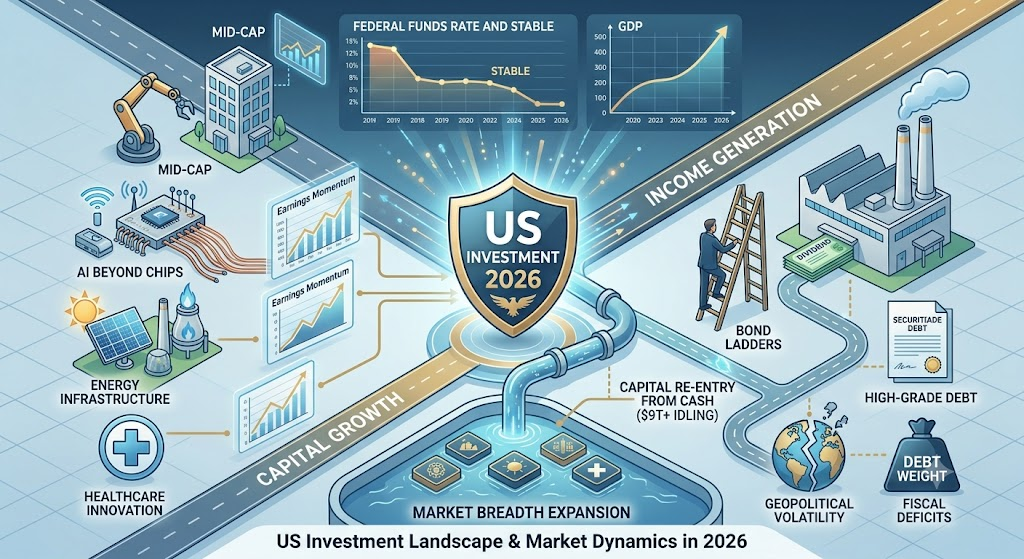
The investment landscape in the United States in 2026 is defined by a shift from pure consumer-led spending toward corporate capital investment and technology-driven productivity. As the Federal Reserve moves through a cautious policy cycle and Artificial Intelligence (AI) scales from infrastructure buildouts into broader economic deployment, institutional and retail investors face a market environment characterized by selective opportunities, structural shifts, and evolving risk factors.
This comprehensive overview analyzes the major asset classes, macro investment drivers, emerging thematic plays, and risk management strategies defining US investments in 2026.
1. Macroeconomic Drivers Shaping US Investing
To construct resilient portfolios in 2026, investors must evaluate four dominant macroeconomic forces:
- Capital Expenditure Supercycle: Corporate spending on data centers, energy grid modernizations, automation, and supply-chain re-shoring is driving industrial and tech productivity gains.
- Interest Rate Normalization: With benchmark rates stabilizing in the mid-3% range, cash is no longer yielding peak emergency returns, prompting money-market capital ($9+ trillion idling across accounts) to re-enter fixed income and equity markets.
- Re-Emergence of Bond Diversification: The traditional negative correlation between stocks and bonds has returned to structural baseline, allowing fixed-income allocations to once again serve as an effective ballast against equity pullbacks.
- Broadening Market Breadth: While mega-cap technology remains central, mid-cap and small-cap US equities are experiencing renewed attention due to lower borrowing costs and improving earnings momentum.
2. Asset Class Breakdown & Performance Expectations
The 2026 market mandates a granular approach within each major asset category.
| Asset Class | 2026 Outlook | Strategic Investment Drivers |
| US Large-Cap Equities | Selective Growth | AI productivity gains, solid corporate profit margins, and robust tech/industrial capex. |
| Small & Mid-Cap Stocks | Outperformance Potential | Rate sensitivity easing debt burdens; market breadth expansion supporting non-mega-caps. |
| Fixed Income (Bonds) | Attractive Yield & Ballast | “Belly of the yield curve” (5-10 year Treasuries) offers strong income lock-in and equity hedging. |
| Real Estate (REITs) | Industrial & Data Dominance | Logistics hubs, data center infrastructure REITs, and selective suburban multi-family properties. |
| Alternative Assets | High Institutional Demand | Private credit, infrastructure funds, and energy transition assets providing inflation-hedged yields. |
| Digital Assets / Crypto | Institutional Integration | Regulated Spot ETFs, income-generating DeFi infrastructure, and stablecoin payment rails. |
3. High-Conviction Investment Themes in 2026
A. The AI Supercycle Beyond Chips
The focus of AI investing in 2026 has expanded beyond primary hardware suppliers to secondary beneficiaries:
- Utilities & Energy Infrastructure: Massive electricity demand from computing facilities has created long-term tailwinds for nuclear, natural gas, and clean-energy grid providers.
- Industrial Automation & Materials: Companies producing sensors, robotics, and raw materials (copper, electrical components) essential for modern manufacturing facilities.
- Enterprise AI Integration: Software and services firms successfully implementing custom AI models to expand profit margins.
B. High-Yield Income Strategies
With interest rates moderating, investors seeking cash flow are building diversified income stacks:
- Dividend-growth equities and option-overlay strategy funds (covered call ETFs).
- Securitized debt, high-grade corporate bond ladders, and municipal bonds.
4. Modern Portfolio Allocation Models
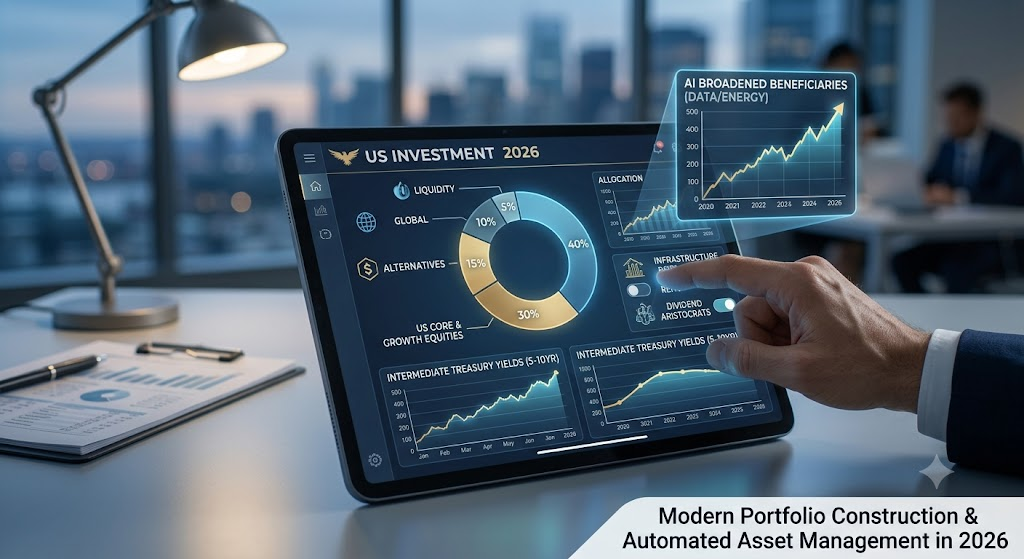
A balanced US growth and income portfolio in 2026 moves beyond the legacy 60/40 mix to incorporate alternative liquidity and targeted sector exposure:
2026 Sample Strategic Portfolio Model:
├── US Core & Growth Equities: 40% (S&P 500, Mid-Cap, AI Broadened Beneficiaries)
├── Fixed Income & Corporate Debt: 30% (Intermediate Treasuries, High-Grade Debt)
├── Global & Emerging Markets: 10% (Tech/Hardware Supply Chain Exposure)
├── Real Assets & Private Alternatives: 15% (Infrastructure REITs, Private Credit)
└── Liquidity Buffer: 5% (High-Yield Cash / Short T-Bills)
5. Key Risks to Monitor
- Geopolitical Volatility & Supply Chains: Ongoing international fragmentation continues to introduce short-term commodity price spikes and logistics bottlenecks.
- High Valuations: Elevated price-to-earnings (P/E) ratios in tech names require disciplined profit-taking and rebalancing.
- Fiscal Deficits: High federal debt issuance maintains pressure on long-term Treasury yields, impacting borrowing costs across the economy.
Summary: 2026 US Investment Playbook
| Objective | Recommended Approach | Key Instruments |
| Capital Growth | Expand beyond mega-caps into mid-caps & broad AI themes. | S&P 500 ETFs, Mid-Cap Indexing, Tech Infrastructure. |
| Income Generation | Lock in yields before further rate cuts. | Intermediate Treasuries, Dividend Aristocrats, Corporate Bonds. |
| Risk Mitigation | Maintain fixed-income ballast and real asset allocations. | Infrastructure REITs, Gold, Treasury Ladders. |
Conclusion
Investing in the United States in 2026 rewards disciplined selectivity over broad market timing. By diversifying beyond mega-cap tech into mid-cap expansion, capturing fixed-income yield, and positioning for infrastructure-driven productivity gains, investors can build resilient, growth-oriented portfolios in a dynamic macro environment.
Leave a Reply