



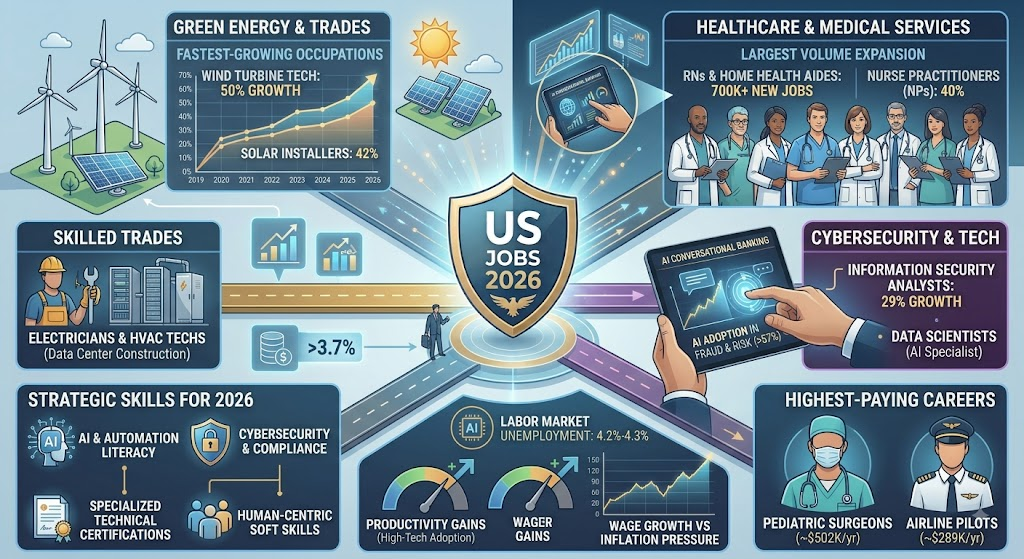
The job market’s gone through a weird reshuffle the last few years. Between AI eating into some roles, an aging population needing more care than ever, and the whole economy sort of recalibrating, “safe career path” doesn’t mean what it used to. Tech, healthcare, and energy are where the money and the demand both are right now — for pretty different reasons, actually.
If you’re thinking about switching fields, just starting out, or honestly just curious where things are heading, here’s a rundown of what’s hiring and what it actually pays — not the inflated numbers you see in headlines, the real range.
Tech, but specifically AI, data, and security
Tech’s still on top, but it’s not “learn to code and you’re set” anymore the way it was a decade ago. The money’s concentrated in three areas: AI/ML, cybersecurity, and data work. Every company, not just tech companies, is scrambling to either build AI into their product or protect themselves from someone hacking in.
AI and machine learning engineers are pulling somewhere in the $130K–$170K+ range, and honestly that number keeps climbing. These are the people building and maintaining the models companies now depend on — a friend who does this at a logistics company spends most of her time tweaking demand-forecasting models so warehouses don’t over- or under-stock before big sales periods. Not glamorous day to day, but clearly valuable.
Cybersecurity analysts sit around $105K–$130K. Every bank, hospital, and government contractor is hiring for this right now, basically non-stop, because the threats keep getting more sophisticated and nobody wants to be the company in next week’s breach headline.
Data scientists and analysts land somewhere around $100K–$135K, doing the unglamorous but essential work of turning a company’s mountain of data into decisions someone can actually act on.
Healthcare isn’t slowing down, period
This one’s less about trends and more about basic math — a huge chunk of the population is aging into needing more care, and that’s not reversing anytime soon.
- Nurse practitioners are increasingly doing what used to be doctor-only work — diagnosing, prescribing, running primary care visits — largely because there just aren’t enough doctors to go around. Pay’s typically $120K–$130K.
- Medical and health services managers, the people running the actual operations and compliance side of hospitals and clinics, pull around $105K–$115K.
- Home health and personal care aides don’t pay much starting out, but this is one of the fastest-growing job categories in the entire country numerically — there’s just enormous demand for people willing to do this work.
Finance and analysis roles that keep companies from making dumb decisions
Nobody wants to get blindsided by inflation or a bad quarter, so companies are paying well for people who can spot problems before they become expensive ones.
Financial managers — the people overseeing capital, investment strategy, long-term planning — are looking at $140K+ typically. Management/business consultants, brought in from outside to find waste and streamline how a company actually runs day to day, tend to land around $95K+.
The trades and clean energy, which people weirdly still overlook
There’s this idea floating around that all the good jobs are behind a screen or in scrubs. Not even close. Skilled trades and renewable energy are dealing with genuine labor shortages right now.
Solar and wind technicians are some of the fastest-growing roles in the country as clean energy infrastructure keeps expanding. Electricians and commercial trades people are in a similar spot — modernizing grids and retrofitting buildings takes hands-on expertise you can’t just automate away.
The part I think gets undersold: most of these don’t need a four-year degree. An apprenticeship or a vocational cert gets you earning real money way faster, and without the student debt hanging over you for a decade after.
What actually connects all of these
Look closely and there’s a pattern across every one of these fields:
They’re hard to automate — either because they need empathy (healthcare), judgment in messy unpredictable situations (trades, consulting), or genuine strategic thinking (basically everything above entry-level). They’re solving problems that aren’t going away — an aging population, cyberattacks, companies drowning in their own data — these are permanent, structural needs, not a temporary blip. And they all demand you keep learning; the tools change constantly, and the people who stay valuable are the ones who keep adapting rather than coasting on what they learned five years ago.
Bottom line
If you’re picking a direction, chase skills over titles. Getting decent at basic data analysis, understanding cybersecurity fundamentals, or specializing in a healthcare niche — any of that opens more doors than a specific job title would, and gives you room to move if one field slows down.