



1. What’s Actually Going On
If you’ve tried to get any kind of loan recently — a mortgage, a car loan, even just a personal loan to consolidate some credit card debt — you’ve probably noticed it feels different than it used to. That’s not just you. Borrowing in America has genuinely changed shape over the last few years, and the cheap-money era most of us got used to in the 2010s and early 2020s just isn’t coming back anytime soon, at least not the way it was.
The short version: the Fed has kept its benchmark rate parked in the 3.5% to 3.75% range, and that filters down into basically everything — mortgages, auto loans, personal loans, credit cards, all of it sitting well above what people were paying pre-2022. Getting a loan today isn’t just about filling out a form and waiting for approval anymore. It actually pays to understand what’s driving these numbers and to go in with a strategy, rather than just taking whatever rate you’re first offered.
Why borrowing costs what it costs right now
It helps to zoom out for a second. Inflation’s been stubborn, sitting around 3% to 3.5% — not the scary post-pandemic spike anymore, but not back to the old 2% target either. The job market’s held up reasonably well, which gives the Fed less pressure to cut rates aggressively. And government bond yields have stayed elevated, which pushes borrowing costs up across the board.
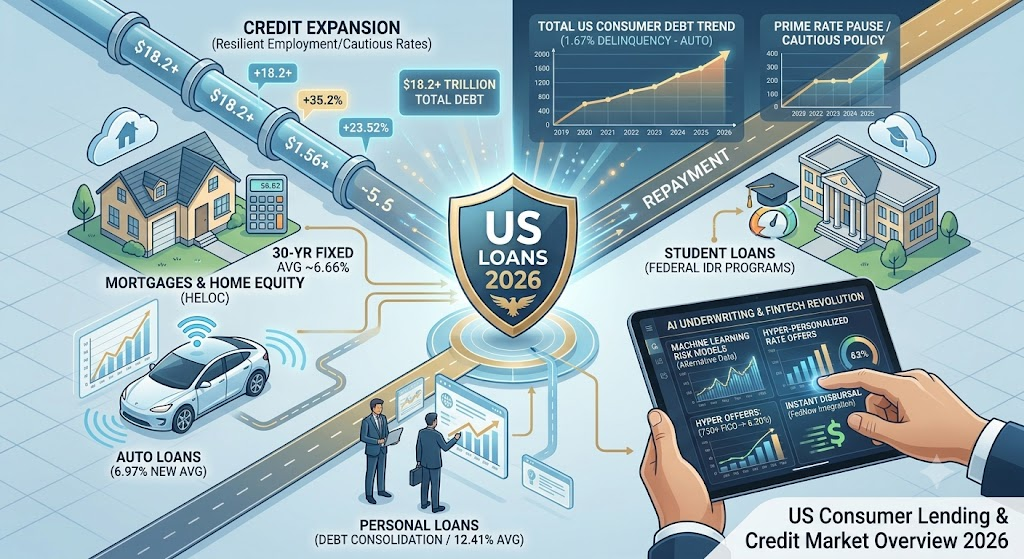
Roughly speaking, right now you’re looking at 30-year mortgages around 6.5% to 6.75%, new auto loans somewhere between 6.8% and 7.5%, personal loans around 11.5% to 12.5% if your credit’s solid, and credit cards sitting at a genuinely painful 21.5% to 24%. Those numbers aren’t just “rates are high” in the abstract — they translate directly into hundreds of extra dollars a month depending on what you’re financing.
On top of that, lenders have gotten more cautious. With total US consumer debt north of $18 trillion and delinquencies creeping up, banks aren’t just glancing at your credit score anymore. They’re scrutinizing your debt-to-income ratio, how stable your income actually is, and whether you’ve got any real cash reserves behind you. Getting approved these days is less about hitting a magic number and more about looking financially boring and predictable, if that makes sense.
Mortgages: living in the “6% world”
Housing is probably where all of this stings the most. The 2.5% to 3.5% mortgage rates people locked in during the pandemic are, realistically, gone for a long while — those were a genuinely unusual moment in history, not a baseline to expect again. Today’s 30-year fixed rates are sitting around 6.5% to 6.75%, with 15-year loans a bit lower, closer to 5.75% to 6%.
One side effect of this that doesn’t get talked about enough is what people are calling the “lock-in effect.” Millions of homeowners who got a 3% rate a few years back are simply refusing to sell, because moving would mean trading that rate for something double. That’s kept housing inventory unusually tight in a lot of major cities, which in turn keeps prices stubbornly high even with borrowing costs elevated — normally you’d expect high rates to cool prices down more than they have.
There’s also been a bit of a comeback for adjustable-rate mortgages — the 5/1 and 7/1 ARMs that fell out of favor for years. They’re offering initial rates maybe 0.75% to 1% below a comparable fixed loan, which is appealing if you’re planning to sell or refinance within the next several years anyway and don’t want to lock into today’s fixed rate for three decades.
A cousin of mine went through this exact math last spring, buying a $400,000 place outside Atlanta. With 10% down, she was financing $360,000, and at 6.6% her principal-and-interest payment came out to a little over $2,290 a month — before taxes and insurance even got added on. She almost went with an ARM to shave the payment down, but ended up sticking with the fixed rate anyway once she ran the numbers on what happens if she’s still in the house past year seven.
Auto loans and the payment shock nobody talks about enough
Car buying has gotten rough in a way that’s easy to underestimate until you’re actually shopping. It’s not just that cars themselves cost more — it’s that combined with higher interest rates, monthly payments have genuinely reached levels a lot of buyers aren’t prepared for. New car loans for people with strong credit are running 6.8% to 7.5%, and if you’re buying used, you’re likely looking at 10% to 12.5%, sometimes more depending on the lender and your credit profile.
To soften that monthly number, a lot of dealers are pushing longer loan terms now — 72 months, even 84 months, has become fairly normal. It works in the sense that it lowers what you pay each month, but it’s worth being honest about the tradeoff: stretching a loan out that long means paying substantially more in total interest, and it raises the odds you’ll end up “underwater” — owing more than the car’s actually worth — for a good chunk of the loan, especially since cars depreciate fast in the first few years regardless of how long you’re financing them for.
Personal loans as an escape hatch from credit card debt
This is probably the one bright spot in an otherwise expensive borrowing landscape. Personal loans have become a genuinely useful tool for people trying to climb out of high-interest credit card debt, mainly because the rate gap between the two is so large it’s hard to ignore. Credit cards are averaging somewhere around 22.5% to 25% APR right now, while a well-qualified borrower can often get a fixed personal loan in the 11.5% to 13.5% range.
Beyond the rate difference, there’s a structural benefit too — credit cards come with variable minimum payments that, if you only pay the minimum, can genuinely stretch your payoff timeline out fifteen or twenty years while interest piles up the whole time. A personal loan, by contrast, is fixed: fixed payment, fixed timeline, usually somewhere in the three-to-five-year range, so you know exactly when you’ll actually be done. For people drowning in card debt with no clear end in sight, that predictability alone is worth a lot, separate from the interest savings.
A guy I used to work with did this last year — he had about $9,000 spread across two cards, both charging north of 23%, and the minimum payments barely made a dent in the principal each month. He rolled it all into a single personal loan around 12% on a four-year term. His monthly payment actually went up slightly compared to what he’d been paying in minimums, but he could finally see an actual end date, and he wasn’t just feeding interest into a black hole anymore.
A few strategies that actually move the needle
Given how expensive borrowing is across the board right now, just accepting whatever rate you’re first quoted is basically leaving money on the table. A handful of things genuinely help.
First, pay attention to credit tier thresholds before you apply for anything major. Lenders sort borrowers into fairly rigid risk buckets, and crossing from one tier into the next — say, moving from the high 600s into the 700s, or from a mid-700s score into the 740+ range — can shave a full percentage point or more off your rate on a mortgage or auto loan. Two concrete things help here: getting your credit card balances down below roughly 10-15% of your total limit a month or so before you apply, since utilization is weighted heavily in most scoring models, and actually pulling your reports from all three bureaus to check for errors — a wrongly reported late payment or a fraudulent account dragging your score down for no real reason is more common than people assume.
Second, don’t just take the first offer from whatever dealership or bank branch you walk into. Pre-qualification tools that use soft credit checks let you shop rates across several lenders without dinging your score, and it’s worth doing before committing to anything. If you do move forward with formal applications that require hard inquiries, try to bunch them together within about a two-week window — credit scoring models generally treat multiple mortgage, auto, or student loan inquiries within that window as a single inquiry, so you’re not penalized repeatedly just for comparison shopping.
Third, don’t overlook credit unions and smaller regional banks. Big national banks tend to have fairly rigid, one-size-fits-all rate structures, but local credit unions and community banks are frequently able to offer meaningfully lower rates — often half a point to a point and a half less — on auto loans, personal loans, and HELOCs, mostly because they’re trying to attract and retain local members rather than maximize margin the way bigger institutions do.
Finally, if you have to borrow right now for something unavoidable, structure the loan so you’re not locked in forever. Make sure there’s no prepayment penalty, so that if rates ease down the road, you’re free to refinance and lock in something better without starting over from scratch. It’s basically borrowing with the expectation that today’s rate is temporary, not permanent.
What to actually check before signing anything
Before committing to any loan in this environment, a few things are worth double-checking rather than assuming. Look at the total interest you’ll pay over the entire life of the loan, not just the monthly payment — a lower monthly payment stretched over a longer term can genuinely cost you more overall, and it’s easy to miss that when you’re focused on affordability month to month. Confirm there’s no penalty for paying down principal faster than scheduled, since that flexibility matters a lot if your income improves or rates drop later. And try to keep your total monthly debt obligations — including whatever new loan you’re taking on — comfortably under 36% of your gross monthly income. That threshold isn’t arbitrary; it’s roughly where lenders start getting nervous, and more importantly, it’s roughly where most people start feeling genuinely squeezed regardless of what a lender thinks.
None of this makes borrowing cheap again — it isn’t, and probably won’t be for a while. But going in with a clear sense of where rates actually stand, what lenders are really evaluating, and a few habits around timing and comparison shopping can meaningfully change what you end up paying, even in a market that isn’t doing you any favors.