

Insurance in USA 2026: Comprehensive Industry Overview & Market Trends
The United States insurance industry in 2026 is navigating a stabilizing yet structural transformation. Following years of aggressive premium hikes and post-inflation shocks, the market is experiencing a mixed transition. While commercial property and cyber insurance lines have moderated, auto, home, and health insurance sectors face persistent cost pressures driven by social inflation, extreme weather, and rising medical expenses.
This complete overview explores key market trends, regulatory shifts, technological revolutions, and strategic risk management practices shaping US insurance in 2026.
1. Macro Economic Environment & Rate Trends in 2026
After nearly a decade of rising commercial Property & Casualty (P&C) premiums, 2026 marks an inflection point with market stabilization in select lines, alongside persistent pressure in liability and personal lines.
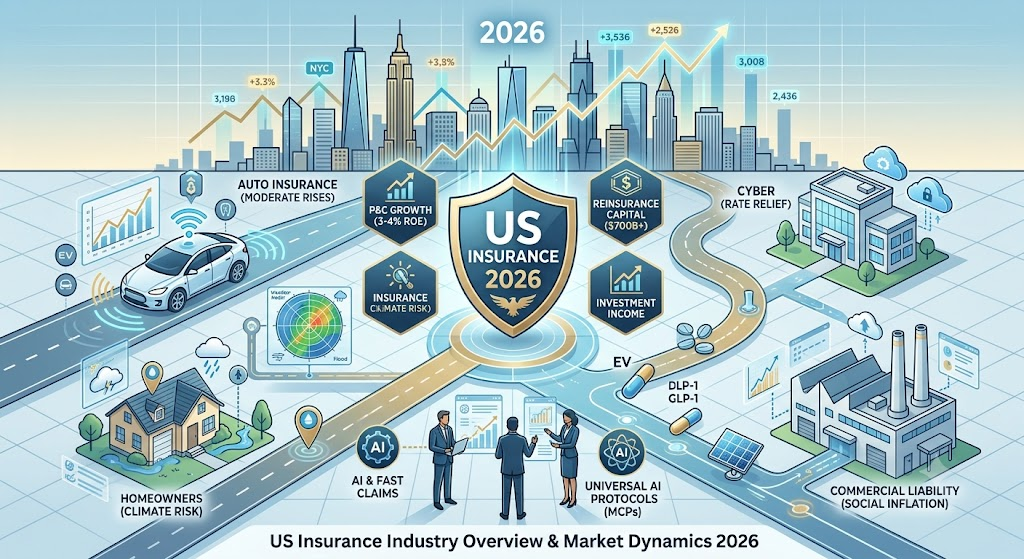
- Moderating P&C Growth: Premium growth across the P&C sector has normalized to 3% to 4% annually, down from double-digit surges seen in previous years. Overall industry profitability has stabilized with Return on Equity (ROE) hovering around 10% to 12%.
- Reinsurance Expansion: Global reinsurance capital has reached historic highs (exceeding $700 Billion), driving new underwriting capacity into commercial property and catastrophe bonds.
- Investment Yields: Higher fixed-income yields (with 10-Year Treasuries above 4%) continue to provide strong investment income for insurers’ reserves, offsetting elevated loss costs.
2. Sector-by-Sector Breakdown
The defining characteristic of the 2026 US insurance landscape is the divergent behavior between property lines and casualty/liability lines.
| Insurance Sector | 2026 Price Trend | Key Market Drivers |
| Personal Auto | +4% to +6% Moderate Increase | Higher repair costs due to smart EV sensors, longer repair cycles, and higher total-loss rates (27%). |
| Homeowners Insurance | +5% to +8% Continued Rise | Climate-driven natural catastrophes, severe weather events, and elevated building material costs. |
| Commercial Property | -2% to -5% Softening / Rate Relief | Record catastrophe bond issuance and increased reinsurance capacity bringing competition back. |
| Commercial Auto & Liability | +3% to +6% Rate Increases | “Social inflation,” third-party litigation funding, and large jury verdicts (“nuclear verdicts”). |
| Cyber Insurance | -3% to -5% Premium Relief | Improved corporate cybersecurity controls, expanded market capacity, and specialized underwriting. |
| Health Insurance | +6% to +9% Premium Growth | High prescription drug expenditures (e.g., GLP-1 weight-loss medications) and rising provider labor costs. |
3. Key Structural Drivers Shaping Insurance

A. Climate Risk & Catastrophe Re-Underwriting
Extreme weather events—ranging from convective storms to wildfires and coastal flooding—continue to redefine risk models. States like Florida, California, Louisiana, and Texas are seeing expanded use of state-backed insurers of last resort, while primary carriers are enforcing stricter roof age limits and wild-fire defensible space requirements before issuing coverage.
B. Social Inflation & Litigation Costs
Casualty insurers face ongoing pressures from “social inflation”—the rising cost of legal claims driven by third-party litigation funding and public sentiment. Large jury verdicts (“nuclear verdicts”) have led insurers to tighten umbrella coverage terms and mandate risk mitigations for corporate fleets.
4. Technology & AI Integration
In 2026, Artificial Intelligence has transitioned from experimental pilots to the primary operating system for top US insurers.
- Agentic AI & Fast Claims: Generative AI agents handle routine claims processing and document analysis, reducing average claim resolution times by up to 40%.
- Universal AI Protocols (MCPs): Insurers are adopting Model Context Protocols (MCPs) to securely connect AI agents with legacy databases, policyholder accounts, and live telematics feeds.
- Telematics & Usage-Based Insurance (UBI): Auto insurers are leveraging real-time driving data (braking, speed, mobile usage) to dynamically price personal and commercial driver policies. Over 35% of personal auto policies in 2026 feature a telematics component.
5. Consumer & Business Strategies for 2026
Navigating the US insurance market in 2026 requires active policy management:
- Optimize Deductibles strategically: Many policyholders are choosing higher deductibles ($1,000 to $2,500) to keep annual personal auto and homeowners premiums manageable.
- Leverage Telematics & Bundling: Combining auto and homeowners policies with a single carrier yields discounts up to 15%–20%, while opting into driving-behavior tracking offers immediate rate reductions for safe drivers.
- Invest in Property Resilience: Homeowners installing wind-resistant roofing, smart water-leak detectors, and clearing wildfire brush receive preferred rates in high-risk zones.
- Commercial Fleet Controls: Businesses managing delivery or commercial fleets must deploy inward/outward dashcams and telematics to secure affordable commercial auto and umbrella coverage.
Summary: US Insurance Market at a Glance
| Indicator / Line | 2026 Market State | Outlook for Policyholders |
| Personal Auto | Moderating increases | Shopping around and telematics yield savings. |
| Homeowners | Regional volatility | Deductible adjustments & property hardening essential. |
| Commercial Property | Buyer-friendly / Softening | Rate cuts and broader coverage available for clean risks. |
| Liability / Casualty | Hardening / Strict terms | Fleet monitoring & risk controls mandatory. |
| InsurTech / AI | Widespread adoption | Faster claims, lower overhead, instant digital servicing. |
Conclusion
The 2026 US insurance sector is entering a period of recalibration. While climate risks and legal liabilities keep pressure on personal lines and commercial liability, expanding reinsurance capacity and AI-driven operating efficiencies are creating a more stable, predictable market for property and cyber lines. Proactive risk management and smart technology adoption remain the best defense against rising coverage costs.