



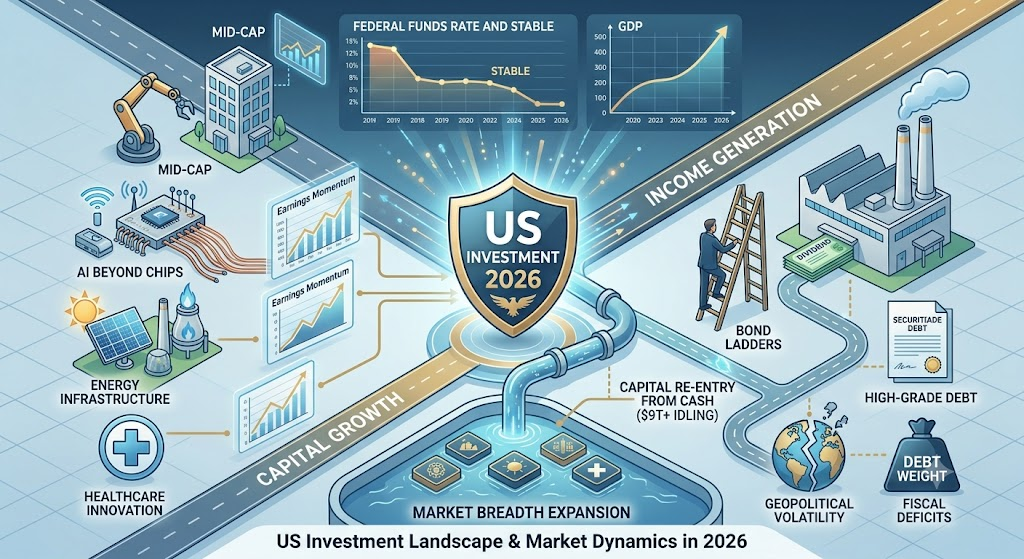
Let’s just start with where things actually stand, because it colors everything else. The Fed’s been holding rates around 3.5–3.75%, mortgage rates are sitting stubbornly at 6.5–6.7%, Americans are collectively carrying something like $18.25 trillion in consumer debt, and inflation, while it’s cooled off from the post-pandemic spike, is still hanging around 3–3.5%. Basically: the free-money, zero-percent-borrowing era is done. Nobody’s bringing it back anytime soon.
None of this means you need to start skipping your morning coffee or living like a monk, though. It mostly means understanding how the system’s actually built right now and setting up a few smart, automated habits instead of white-knuckling it every month.
Forget budgeting, think cash flow
The word “budget” makes most people wince — it sounds like punishment. But a real cash-flow system does the opposite: once your priorities are covered, it tells you exactly what you’re free to spend without guilt.
50/30/20 is still the framework that holds up best: half toward needs, thirty percent toward wants, twenty toward savings and your future self.
Take Marcus — he’s a product manager in Chicago pulling about $100K, which lands at roughly $6,200 a month after taxes and healthcare deductions. He doesn’t track every coffee purchase in a spreadsheet; he just has his paycheck auto-split the day it hits. About $3,100 routes straight to a bills account that covers his $2,200 rent plus utilities, groceries, transit. Another $1,240 goes straight into his HYSA and Roth IRA before he even sees it. The remaining $1,860 lands in his regular checking, and he spends every dollar of it guilt-free — dinners, concerts, whatever — because everything important is already locked down.
Where you park your cash actually matters
With rates where they are, it’s genuinely wild how many people still keep their emergency fund in a big-name bank like Chase or Bank of America earning basically nothing — 0.01% to 0.05% APY. That’s not safety, that’s just letting inflation quietly eat your savings while you’re not looking.
A high-yield savings account is the same thing, functionally — still FDIC-insured up to $250K — it just pays what the market’s actually offering, typically 3.5–4.5% right now.
Elena’s a good example. She’s got $20,000 sitting in savings. Left in a standard legacy account at 0.01%, that earns her a grand total of two dollars a year — I mean, genuinely, two dollars. Move the exact same $20,000 into an online HYSA paying 4%, and suddenly it’s earning $800 a year, doing literally nothing different except picking a better account.
Buying a home in the “6% world”
Housing’s rough right now, no way around it. Thirty-year fixed rates sitting at 6.5–6.7% feels brutal compared to the sub-3% rates people got used to during the pandemic — and honestly, those days probably aren’t coming back for a while.
So people are adapting instead of waiting it out. Some are buying now with the plan to refinance if rates ease toward 5–5.5% down the line — “date the rate, marry the house,” as the saying goes. Meanwhile, homeowners who locked in 2.5–3.5% years ago are mostly staying put and using HELOCs to renovate rather than sell, which is honestly part of why housing inventory’s stayed so tight.
David and Priya are a decent illustration — they’re looking at a $400K starter home in Dallas, putting 10% down, financing $360,000. At 6.5%, their monthly principal and interest lands around $2,275, before taxes and insurance even get added in. Rather than stretch to the absolute max, they capped their housing costs at 28% of gross income and went slightly smaller on the house so they could still put $500 a month into retirement without feeling squeezed.
Credit card debt is where a lot of people quietly get stuck
Total credit card debt in the US has crossed $1.1 trillion at this point, and with average APRs running 21–28%, carrying a balance month to month is genuinely one of the worst financial habits you can have.
Using a credit card day-to-day is actually the smarter move over debit — it keeps your real checking account insulated from fraud and data breaches — but the rule has to be non-negotiable: pay the entire statement in full, every month, no exceptions.
Jessica’s story is a good one here. She had $6,000 spread across two cards at 24% interest, minimum payments around $180 a month. At that rate, paying minimums alone would’ve taken her past four years and cost her thousands extra in interest. Instead she tightened her spending and threw an extra $300 a month specifically at the higher-interest card — the “avalanche” approach — and cleared the whole $6,000 in under fourteen months, saving over $2,500 in interest she would’ve otherwise handed to the bank.
Actually building wealth means investing, not just saving
Savings protects you from emergencies. It doesn’t really grow your money — inflation sees to that. Long-term wealth in the US pretty reliably comes down to low-cost index funds (S&P 500, total market, whatever) combined with the right tax-advantaged accounts.
The order that tends to make the most sense: first, put enough into your 401(k) to get the full employer match — that’s free money, an instant 100% return, don’t leave it on the table. After that, max out a Roth IRA if you can (currently capped around $7,000/year) — contributions are after-tax, but growth and withdrawals in retirement are completely tax-free. If you’re on a high-deductible health plan, an HSA is worth maxing too, since it’s one of the only accounts that’s tax-free going in, growing, and coming back out for medical expenses. Only after all that does it usually make sense to go back and finish maxing the 401(k) or start a regular taxable brokerage account.
Alex is a good compound-growth example — started putting $300 a month into an S&P 500 index fund at 25. Over 30 years, assuming a fairly typical 8% average return, Alex personally contributes $108,000 out of pocket. The account ends up worth somewhere around $438,000 by 55. Most of that growth isn’t Alex’s money — it’s compounding doing what compounding does.
The small stuff still adds up to real money
Money problems in America rarely come from one dramatic mistake. It’s usually just a slow drip of small charges nobody’s paying attention to.
The average household is juggling somewhere between four and seven active subscriptions — streaming, app tiers, cloud storage, fitness apps — quietly costing $150 to $250 a month combined. And buy-now-pay-later services like Klarna or Affirm make a $200 purchase feel like nothing by splitting it into four $50 payments, but stack four or five of those running at once and you’ve basically locked up a chunk of next month’s paycheck already.
Sam ran what he called a fifteen-minute “leak audit” — just pulled his last 60 days of statements and highlighted every recurring charge. Turned out he was paying $32 a month for two streaming apps he never opened, $15 for a delivery membership he’d forgotten about, $55 for a gym he hadn’t set foot in for three months, and $20 for some software tier he didn’t need. Canceling all four saved him $122 a month — almost $1,500 a year — which he just redirected straight into his Roth IRA.
Where to actually start
You don’t need to overhaul everything this weekend. If you’re picking a starting point: get your emergency cash into a high-yield savings account, set up an automatic paycheck split along the 50/30/20 lines, make sure you’re capturing your full 401(k) match, commit to paying credit cards in full every month, go do one quick subscription audit, and set up even a small automatic transfer into an index fund.
None of it is complicated. It’s mostly just automating the boring parts once so you’re not relying on willpower every single month.