


The New Enterprise Backbone, Autonomous Systems & Market Landscape
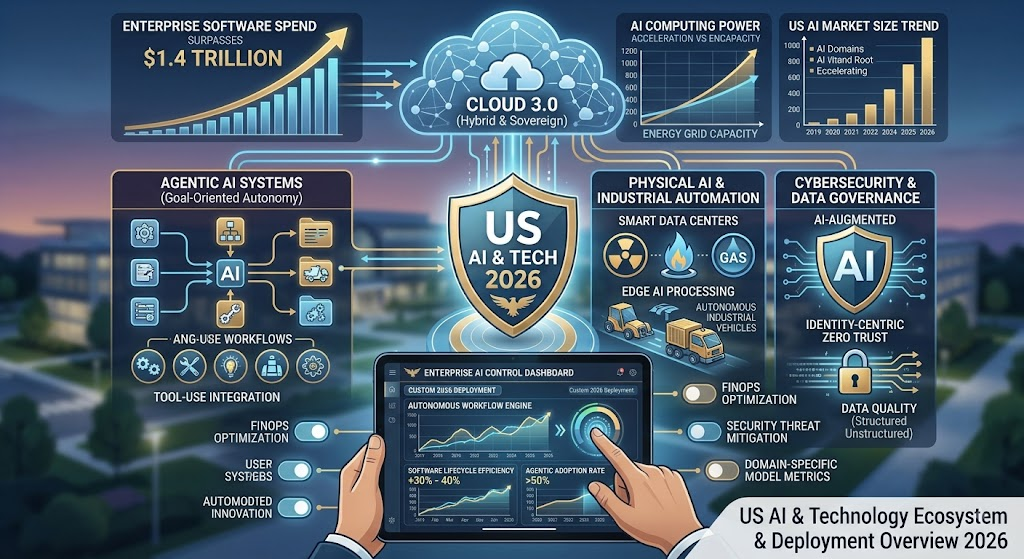
In 2026, Artificial Intelligence (AI) and modern technology in the United States have crossed the threshold from experimental pilots to the primary operational backbone of the national economy. Driven by the rise of Agentic AI, specialized hardware integration, “Cloud 3.0” hybrid architectures, and autonomous workflows, enterprise technology spending in the US is scaling beyond $1.4 Trillion.
This comprehensive article delivers an in-depth breakdown of AI and Technology in the USA in 2026—covering agentic automation, AI-driven software development, physical AI/robotics, cloud sovereignty, cybersecurity arms races, and high-yield strategic implementation models.
                                  +-------------------------------------------------------+
                                  |                 US AI & TECH ERA 2026                 |
                                  |           (Enterprise Software > $1.4T)               |
                                  +---------------------------+---------------------------+
                                                              |
                 +--------------------------------------------+--------------------------------------------+
                 |                                            |                                            |
                 v                                            v                                            v
     +-----------------------+                    +-----------------------+                    +-----------------------+
     |      AGENTIC AI       |                    |     PHYSICAL AI &     |                    |      CLOUD 3.0 &      |
     |   AUTONOMOUS WORKFLOW |                    |  ROBOTICS INTEGRATION |                    |   DATA GOVERNANCE     |
     +-----------+-----------+                    +-----------+-----------+                    +-----------+-----------+
                 |                                            |                                            |
                 +--------------------------------------------+--------------------------------------------+
                                                              |
                                                              v
                                  +-------------------------------------------------------+
                                  |              AI-AUGMENTED ZERO-TRUST SECURITY         |
                                  +-------------------------------------------------------+
1. The Paradigm Shift: From Assistive Copilots to Agentic AI
The defining technological shift in 2026 is the transition from generative “copilots” (which assist human actions) to Agentic AI systems capable of independent reasoning, multi-step planning, and autonomous execution.
Key Characteristics of 2026 Agentic AI:
- Goal-Oriented Autonomy: Rather than simply generating text or code snippets, AI agents execute complex, multi-system workflows—such as supply chain re-routing, financial reconciliations, and automated software deployment—with minimal human intervention.
- Tool-Use Integration: AI systems dynamically interface with enterprise APIs, databases, and third-party software, making real-time operational decisions based on live streaming analytics.
- Human-in-the-Loop Oversight: Modern deployments prioritize hybrid collaboration, where AI agents handle repetitive, complex workflows while human oversight manages exceptions and high-stakes strategic choices.
2. Sector-by-Sector Breakdown of AI & Tech Trends
The reach of AI extends across every core layer of the 2026 technology ecosystem:
| Tech Sector | 2026 Market Dynamics | Strategic Impact & Drivers |
| Enterprise Software | Expenditure surpassing $1.4 Trillion | Shift to composable architecture with embedded machine learning models. |
| Software Engineering | “Intent-Based” Development | Developers articulate systemic intent; AI generates, tests, and maintains codebase. |
| Cybersecurity | AI-Augmented Zero-Trust | Real-time threat detection and automated incident response counter AI-driven cyber threats. |
| Cloud Computing | “Cloud 3.0” Hybrid Models | On-premise, multi-cloud, and sovereign cloud systems tailored for private model training. |
| Physical AI & Robotics | Smart Infrastructure & IoT | Autonomous logistics, industrial humanoid testing, and AI-enabled edge hardware. |
3. Physical AI & Industrial Automation
In 2026, digital intelligence is merging directly with physical assets:
Key Physical AI Innovations:
- Edge AI Processing: Specialized hardware and custom silicon chips allow AI models to process massive sensor streams locally inside vehicles, factories, and medical devices without cloud latency.
- Next-Gen Industrial Robotics: Factories across the US Sunbelt and Midwest leverage spatial intelligence and robotics to automate warehouse logistics, precision assembly, and heavy equipment operations.
- Smart Energy & Data Centers: AI workloads have driven unprecedented electricity demand, prompting massive technology investments in smart grid management, natural gas microgrids, and nuclear power contracts for data center operations.
4. Cybersecurity & Data Governance: The AI Arms Race
As AI capabilities expand, data security and governance have become foundational prerequisites for enterprise adoption.
                    ┌─────────────────────────────────────────────────────────┐
                    │               AI DATA GOVERNANCE & SECURITY             │
                    └────────────────────────────┬────────────────────────────┘
                                                 │
                  ┌──────────────────────────────┴──────────────────────────────┐
                  ▼                                                             ▼
┌───────────────────────────────────┐                         ┌───────────────────────────────────┐
│     AI-AUGMENTED THREAT DEFENSE   │                         │    DATA QUALITY & PRIVACY (1033) │
│ • Automated Incident Containment  │                         │ • Direct API Encrypted Pipelines  │
│ • Identity-Centric Zero Trust     │                         │ • Elimination of Screen Scraping  │
│ • Real-time Threat Escalation     │                         │ • Structured Unstructured Data    │
└───────────────────────────────────┘                         └───────────────────────────────────┘
- Mitigating Shadow AI: Enterprises are replacing unauthorized, employee-sought AI tools with secure, enterprise-sanctioned AI environments backed by strict data lineage rules.
- Identity-Centric Zero Trust: Security architectures evaluate user identities and automated AI agent permissions continuously in real time to prevent unauthorized access.
- Structured Data Foundations: Intelligent Document Processing (IDP) organizes unstructured corporate data (contracts, PDFs, logs), providing verified datasets required for fine-tuning custom AI models.
5. Comparative Analysis: AI & Technology Metrics in 2026
| Tech Indicator / Area | 2026 Industry Benchmark | Strategic Enterprise Priority |
| Enterprise Software Spend Growth | +14.7% YoY ($1.4T Total) | Direct investment in AI platforms and automation. |
| Agentic AI Adoption Rate | >50% of US Enterprises | Moving from pilot testing to core operational execution. |
| Data Center Infrastructure Capex | High Acceleration | Securing energy supplies & custom hardware clusters. |
| Software Lifecycle Efficiency | 30%–40% Faster Deployment | Autonomous testing, debugging, and code migration. |
6. Strategic Implementation Playbook for Businesses
To maximize ROI on AI and technology investments in 2026, organizations are following four strategic imperatives:
- Prioritize Data Infrastructure First: Clean, well-governed, and structured data is the non-negotiable prerequisite for scalable AI performance.
- Adopt FinOps for Cloud & AI Computing: Implement cloud cost discipline (FinOps) to manage computing usage and optimize model inference costs across hybrid architectures.
- Transition from Coding to Orchestration: Upskill software development teams from writing basic syntax toward system architecture, AI orchestration, and security oversight.
- Deploy Domain-Specific AI Models: Utilize smaller, highly specialized LLMs fine-tuned on proprietary business data rather than relying solely on massive general-purpose public models.
Summary: US AI & Technology Landscape at a Glance
| Technology Pillar | 2026 State | Primary Outlook |
| Agentic AI Systems | Production Deployment | High operational efficiency and automated decisioning. |
| Software Engineering | Intent-Driven Architecture | AI-assisted code generation and autonomous maintenance. |
| Cloud Infrastructure | Hybrid & Sovereign (Cloud 3.0) | Diversified cloud environments for security & latency control. |
| Cyber Defenses | AI vs. AI Security Arms Race | Identity-centric architectures with automated threat response. |
Conclusion
The US AI and technology sector in 2026 is defined by maturity, execution, and structural integration. As organizations move beyond initial experimentation into scalable, agentic AI deployment, competitive advantage belongs to enterprises that build strong data foundations, enforce robust security governance, and combine AI efficiency with strategic human decision-making.